


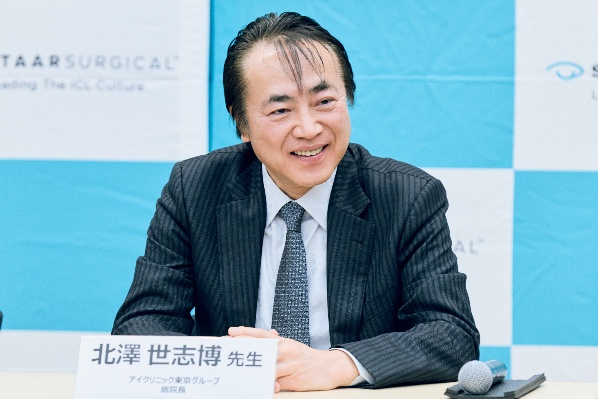
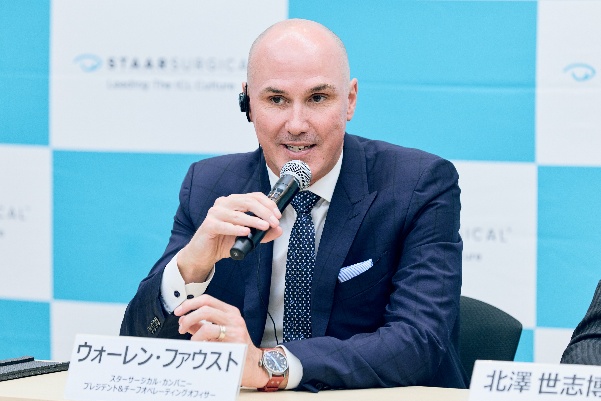
On January 27, Dr. Yoshihiro Kitazawa, Chief Director of our group, participated as a speaker at a media seminar held in Tokyo and hosted by STAAR Surgical Company:
“Myopia Treatment in 2030: Global Trends and the Future of Refractive Correction in Japan.”
During the seminar, Warren Foust (President & Chief Operating Officer of STAAR Surgical) and Dr. Kitazawa delivered lectures, followed by a panel discussion.
Warren Foust explained that since 2020, the global prevalence of childhood myopia has been increasing due to greater use of smartphones and computers. Currently, approximately 55% of people in Asia are myopic, and this figure is projected to reach 65% by 2050. He also highlighted that progression to high myopia increases the risk of vision-threatening conditions such as retinal detachment and macular degeneration.
Under these circumstances, Phakic Intraocular Lens (ICL) has gained attention as a treatment for myopia, hyperopia, and astigmatism. He introduced that ICL does not require corneal removal and is reversible, as the lens can be removed in the future if needed.
Dr. Kitazawa explained that the standard age indication for ICL is 21 to 45 years, with most currently performed in patients in their 20s and 30s. However, with the growing popularity of ICL, interest among individuals aged 40 and older is increasing. The primary reasons patients choose ICL are to decrease life burden such as Inconvenience of glasses or contact lenses, Complexity of contact lens care, Desire to avoid reading glasses.
He also noted that, as of 2023, Japan is the only country where the number of ICL procedures exceeds LASIK procedures worldwide. Under Japan’s certification system, procedures are strictly managed by certified specialists. Currently, approximately 380 certified ICL institutions exist in Japan, and appropriate knowledge among certified surgeons and proper patient selection help protect patients’ long-term visual outcomes.
During the panel discussion, both speakers shared the following perspectives regarding myopia treatment:
Around 2008, approximately 200,000 LASIK procedures were performed annually. However, due to limitations in treating high myopia and issues such as postoperative dry eye, the number has declined to approximately 20,000 cases per year. In contrast, ICL has increased in popularity because its reversibility provides reassurance to patients, as the implanted lens can be removed if myopia progresses.
Although some patients still feel uneasy about implantable intraocular lens, psychological resistance is gradually decreasing with increased clinical experience and public awareness. In 2023, ICL accounted for more than 70% of refractive surgeries in Japan and is expected to become a central treatment for myopia due to its safety and effectiveness. Based on past complications associated with LASIK, the speakers emphasized that appropriate patient selection and accurate patient education are essential for the safe expansion of ICL.